
Anatomy of a Kitchen Knife
When discussing knives, it is useful to align around some basic terminology.
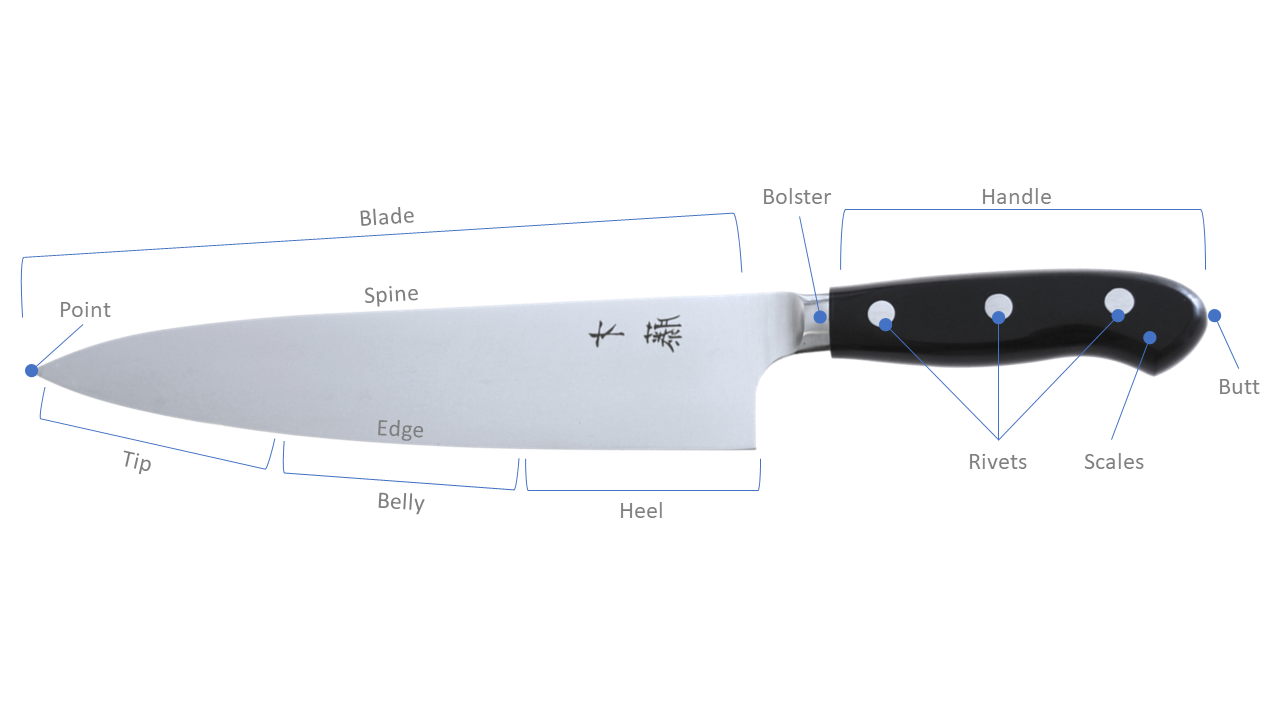
Blade
The thin piece of metal extending from the handle, including the cutting edge. Different types of knives are defined by different blade lengths and shapes.
From back-to-front, the blade has different sections:
-
Heel: the portion of the blade closest to the handle, usually reserved for cutting tasks requiring more force
-
Belly: the middle portion of the blade, where most cutting action happens
-
Tip: the portion of the blade furthest from the handle, usually reserved for delicate cutting tasks
-
Point: the very end of the knife, at the end of the tip, where the spine meets the cutting edge.
Front top-to-bottom:
-
Spine: the top of the blade, opposite the cutting edge.
-
Edge: the sharpened section of the blade, at the bottom, designed to cut or slice
Bolster
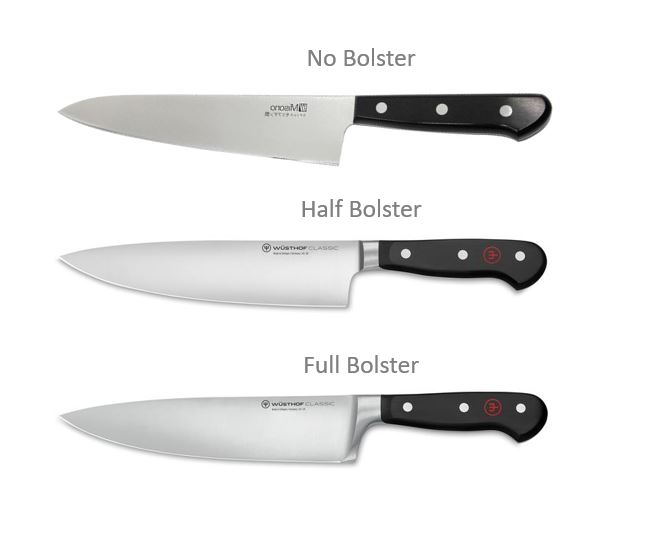
A thickened section of metal where the blade widens considerably and meets the handle. On some knives, the bolster runs all the way down to the heel of the blade. On others, the bolster is higher up near the handle only. And some knives don’t have a bolster at all.
Handle
The part of the knife that you grip with your hand. The handle can be made from wood, plastic, rubber, or a variety of other materials, and is often contoured to fit comfortably in your hand.
-
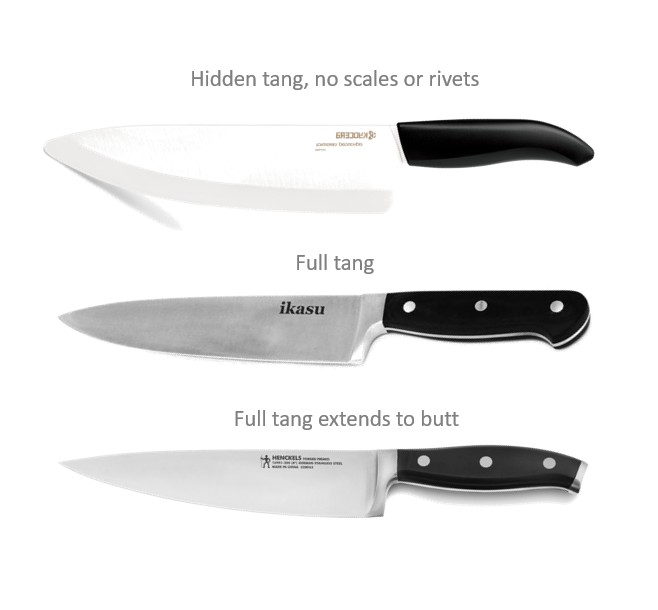
Tang: the metal that the blade is made of extends back into the handle, and the portion in the handle is known as the tang. If the knife is a “full tang” knife, the metal extends all the way to the butt.
-
Scales: if the handle is made of a material that sandwiches a full tang, the two pieces of material are known as scales. Other one-piece handles are molded on.
-
Rivets: scales are often secured with rivets that penetrate through the tang.
-
Butt: the end of the handle, sometimes reinforced with metal.