
Assessing Sharpness
There are a variety of ways to judge the sharpness of a blade. Here we discuss some of the most common, as well as how we measure ourselves in the shop.
Shave the hair on your arm
There is a reason that our forearms in the shop are hairless… this is perhaps the quickest and easiest way to see if a blade is really sharp. A very sharp knife will shave the hairs off your arm in a single pass, but this level of sharpness is difficult to attain, requiring very fine abrasives and experience using them. I’d be willing to bet that none of the knives in your kitchen pass this test, even if you have recently sharpened them. Even a reasonably sharp knife will just push the hairs on your arm over without cutting them.
Pros
-
Quick and easy. Everyone has a forearm close by!
-
An awesome litmus test for “scary sharp”.
Cons:
-
Be careful. This could hurt.
-
A knife can perform very well in the kitchen without attaining this level of sharpness. This goal is unnecessarily lofty for most home cooks.
-
This is a qualitative measure, and results could differ based on the thickness of the hair, cutting with or against the grain, and other factors.
Slice a tomato
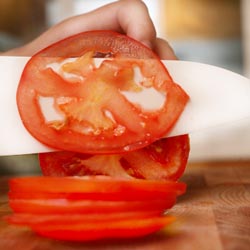
A ripe tomato is often used to judge sharpness because it’s tough skin and soft interior is a great test for a blade. A sharp knife will slice cleanly through the skin with the lightest of pressure, without squishing the interior of the fruit. A dull knife requires more pressure and/or a sawing motion to get through the skin. The added pressure will bruise the inside of a ripe tomato, and the sawing motion is an inefficient way to process an entire fruit.
Pros
- Representative of what your knives are expected to do in the kitchen.
Cons
-
This is a qualitative measure, and results can differ based on the ripeness of the tomato.
-
Unless you happen to be making a BLT, this test could be wasteful and requires something you may not have lying around.
Cut paper
Another great way to gauge sharpness is to hold a piece of paper vertically between your thumb and forefinger, then use a downward slicing motion with your knife to cut the paper. A dull knife will crumple the paper or cut a short section before tearing the rest. A sharp knife will cleanly slice the paper over the entire length of the blade. A super sharp blade will cut the paper with downward force only - no slicing action. If your knife reliably cuts paper with part of the blade, but then catches or struggles with another part of the blade, it is a good indication that the blade is not uniformly sharp over the length of the cutting edge or has a nick that needs to be repaired.
Pros
-
Most folks have plenty of paper lying around.
-
Identifies dull spots, burr remnants, or knicks on a blade that is otherwise sharp.
Cons
- This is a qualitative measure, and results can differ significantly based on the type of paper, the way it is held, and the slicing motion of the blade.
Reflect light off the cutting edge
Turn the knife upside down with the cutting edge pointing straight up under a bright light. Tilt the edge a little to the right, then a little to the left. A dull knife will reflect some of that light back up to your eye and a very dull knife will reflect a lot. A sharp knife is “invisible” and won’t reflect any light.
It’s better to think of this method as a way to assess dullness than a way to assess sharpness. Meaning, this technique won’t tell you if a knife is moderately sharp or very sharp because neither blade will reflect light from the cutting edge. But it will tell you if a knife is moderately dull or very dull.
Pros
-
Quick and easy, needing access only to a good light source (the sun will usually do if you are outside)
-
Identifies dull spots across the length of the blade, not just one spot
Cons
-
Qualitative measure dependent on lighting environment
-
Only useful up to a certain level of sharpness, beyond which no blade will reflect enough light to visualize the cutting edge
Quantify with an instrument
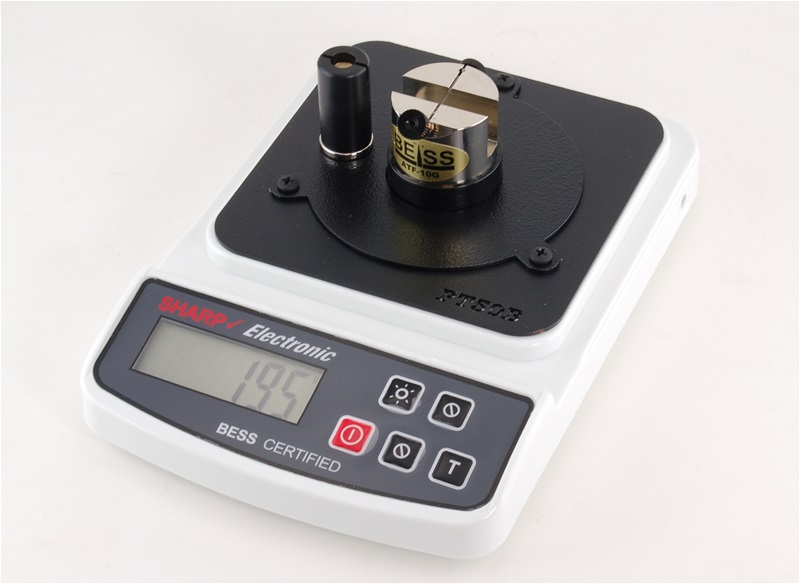
Here in the shop, we have invested in a specialized machine to help us evaluate the quality of our work. The Edge-On-Up Edge Tester measures the amount of force necessary to slice a standardized testing medium. This means that every blade can be assigned a precise score and benchmarked to our standards.
Pros
-
Allows for the sharpness of a blade to be quantified, no matter how dull or how sharp
-
Consistency between measurements done days or months apart
Cons
-
Expensive
-
Measures sharpness at only one point along the blade
-
Testing limited to shop